Take-offThe problem
- 01
Low intent to nurture
Motivation fades after a few weeks.
- 02
No joy in choosing
A plant is hard to personalise.
- 03
Not enough know-how
Care takes knowledge most receivers lack.
- 04
Low recall
Out on the balcony, out of mind.
Nobody brags about a plant
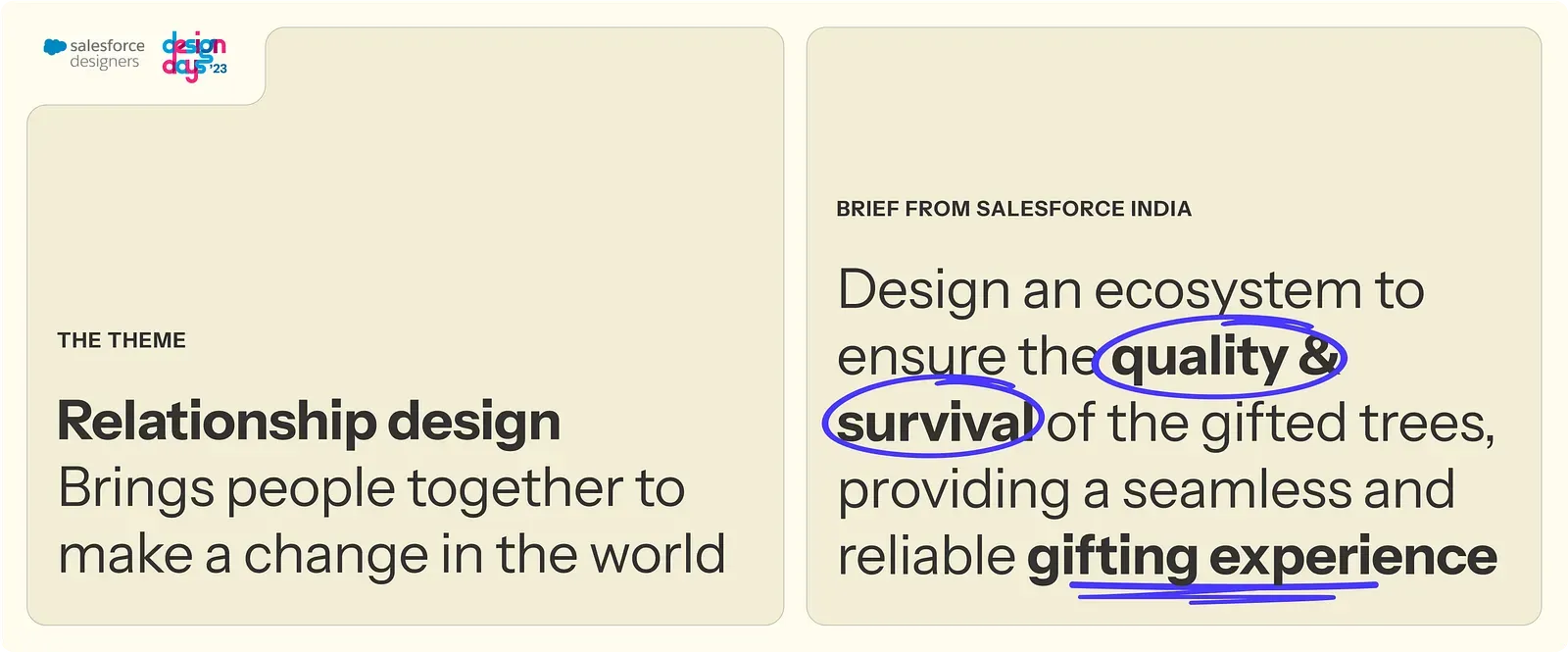
The brief from Salesforce India asked us to make plant gifting brag-worthy. People choose gifts the receiver can proudly show off, and a plant on a balcony is easy to forget.
Read the full story
The challenge — Making plant gifting a brag-worthy proposition
In early October, we set out to solve the design brief from Design Days 23’ from Salesforce India.
First thought
In this era, where showing off & status quo are so important, why would someone think of gifting plants?
If you ever notice, people tend to choose gifts the receiver can proudly showcase. There’s an unspoken rule: ‘The more brag-worthy the gift, the more impressive the giver.’
That’s why you see people flaunting fancy perfumes and shiny watches. Ever thought of gifting a plant? Most likely, we all consider a bouquet.
Diving deep into the gifting space
We engaged with 7 individuals who love gifting something (literally anything) to their loved ones.
Our goal here was to understand the process of gifting from the very start —
- How do people choose gifts for their loved ones?
- How do they make the gifts personalized & memorable?
- How do people look at plants as gifts?
Understanding the hesitation in plant gifting
While plants are often given as housewarming gifts, they seem to lose their appeal as gifts for other occasions. This lack of adoption can be attributed to several factors -
- Low intent to nurture plants — The gift receiver may not have an active interest in planting, leading to losing motivation to maintain plants after some time.
- Missing joy of gift selection — One of the most interesting things about gifting something is the dopamine rush you get while selecting the gift & curating it. In the case of plants, the sender cannot personalize or curate the plant for the receiver.
- Lack of knowledge to nurture plants — The plant receiver may not have enough knowledge to maintain and nurture the plant! There is some intrinsic interest needed for someone to learn the nuances of gardening.
- Low recall value — Plants are easily forgotten as they aren’t part of our daily routines like watches or perfumes. Often situated on balconies, they have fewer and less memorable interactions.
CruiseThe work
Plant partners
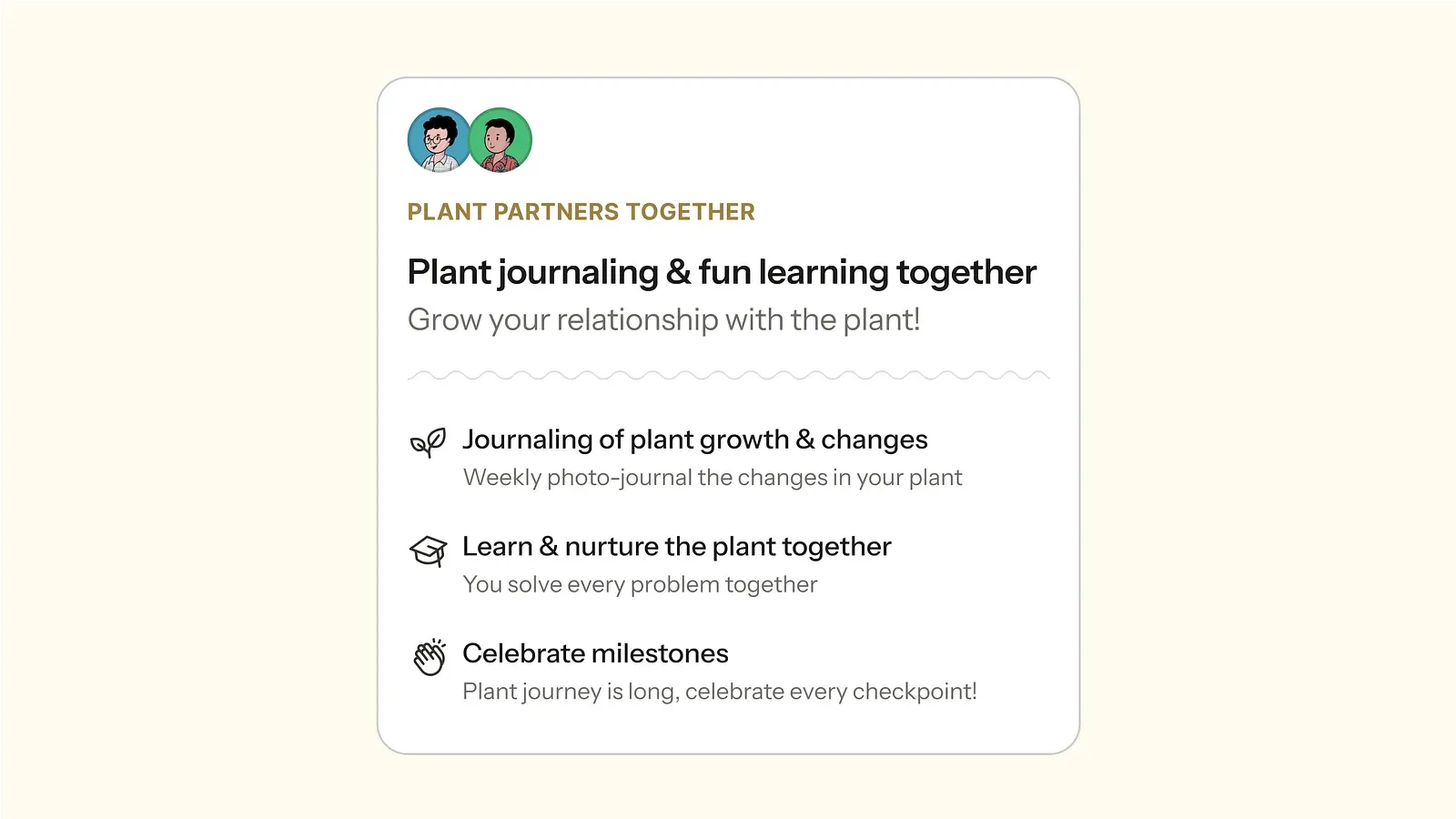
Planting alone is as dull as studying alone. In Leafish, two people nurture plants together in their own homes, around a shared plant journal.
Read the full story
Summing up the problem
Plants are unpopular gifts due to a lack of excitement and the absence of plant nurturing habits, leading to declining efforts and, ultimately, the potential demise of the plant
The opportunity ~ Excitement via partnerships
Okay, going back to study time for our exams, is boring, right? Planting alone seems boring too. What if you do it with someone you enjoy spending time with?
How might we make planting fun, and collaborative, and include learning on the go while fostering shared bonds over plants?
The path to maximum adoption
The spectrum of people nurturing plants involves 2 sides —
- Individuals who put in the least effort, cause concerns about the plant’s survival.
- Individuals are willing to invest the utmost effort, but the question arises — are many people ready to take up this challenge? Mostly, no!
The sweet spot lies in finding the right balance between efforts and introducing motivation for them to continue.
We believe nurturing a plant with your favorite people is the sweet spot.
Introducing Leafish

Wait, what are plant partners?
Plant partners is a concept wherein 2 people nurture plants together at their respective homes. It’s all based on the concept of shared plant journaling.
Defining the target users
Sender — People who want to gift something thoughtful to their loved ones.
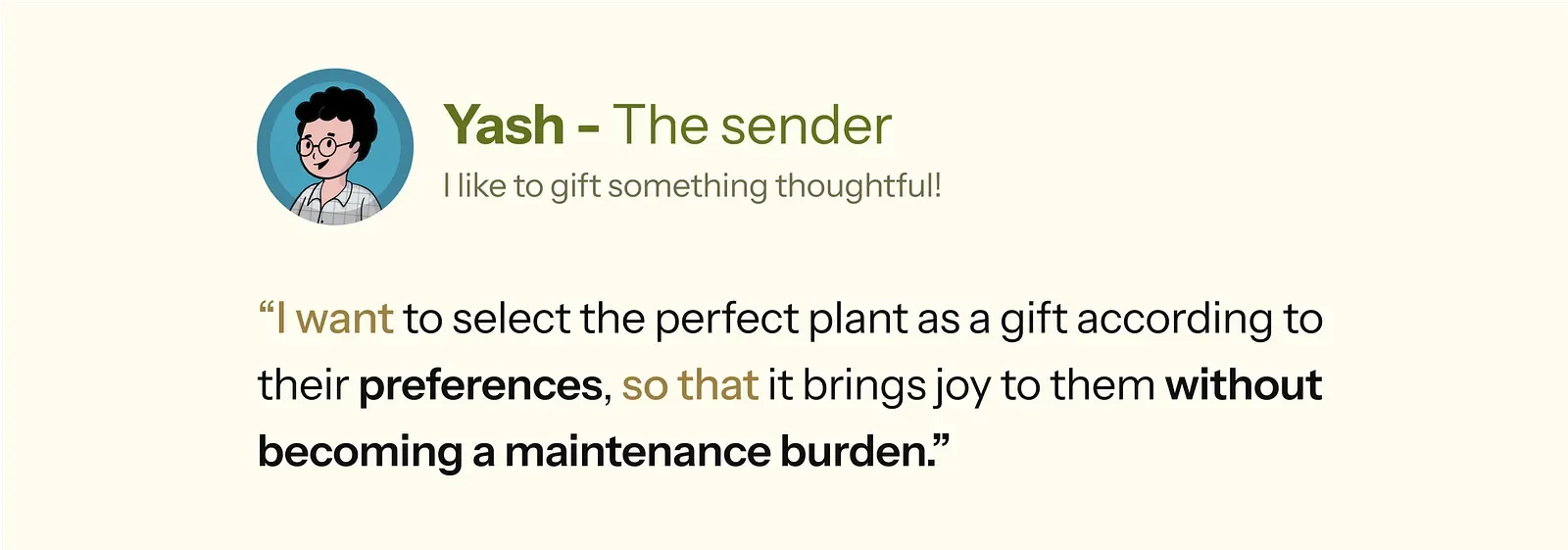
Now, let’s dive deep into Yash’s journey of gifting his best friend Sneha!
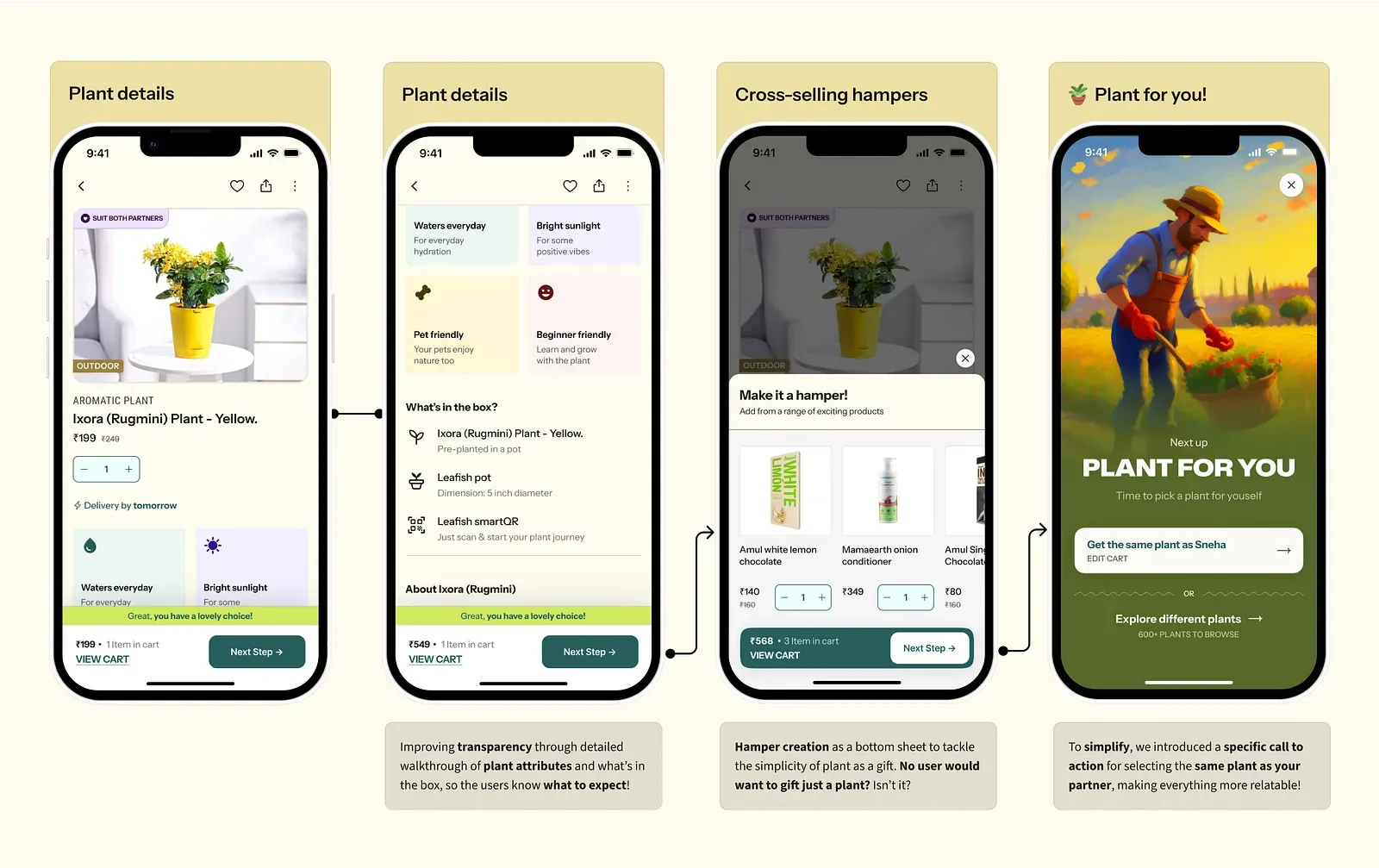
Gifting that feels like building your own order
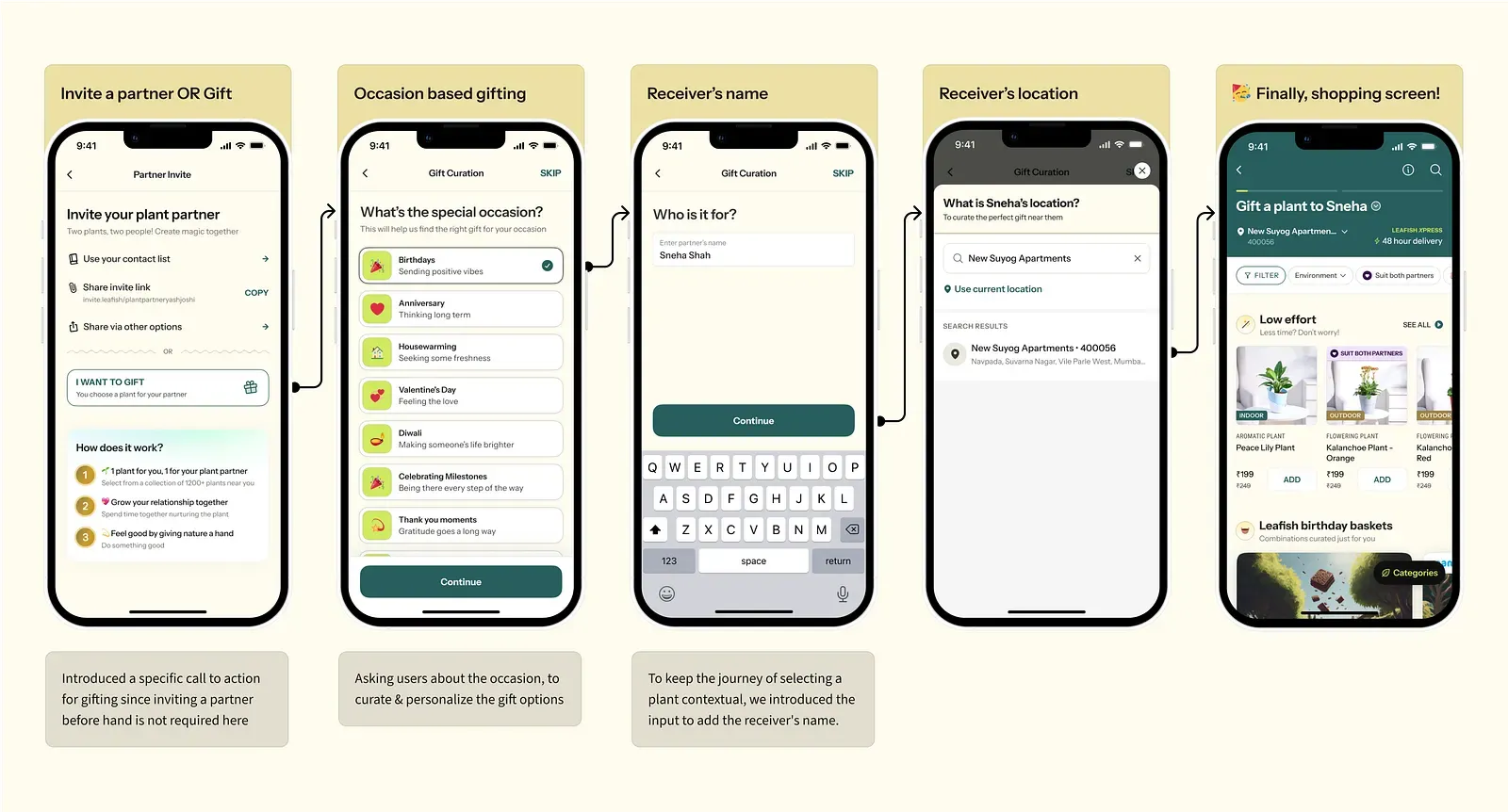
Buying two plants, one for you and one for your partner, should feel as freeing as putting together your favourite Subway sandwich. A simple nudge to choose the same plant keeps both partners on the same page and saves choosing twice.
Read the full story
Onboarding
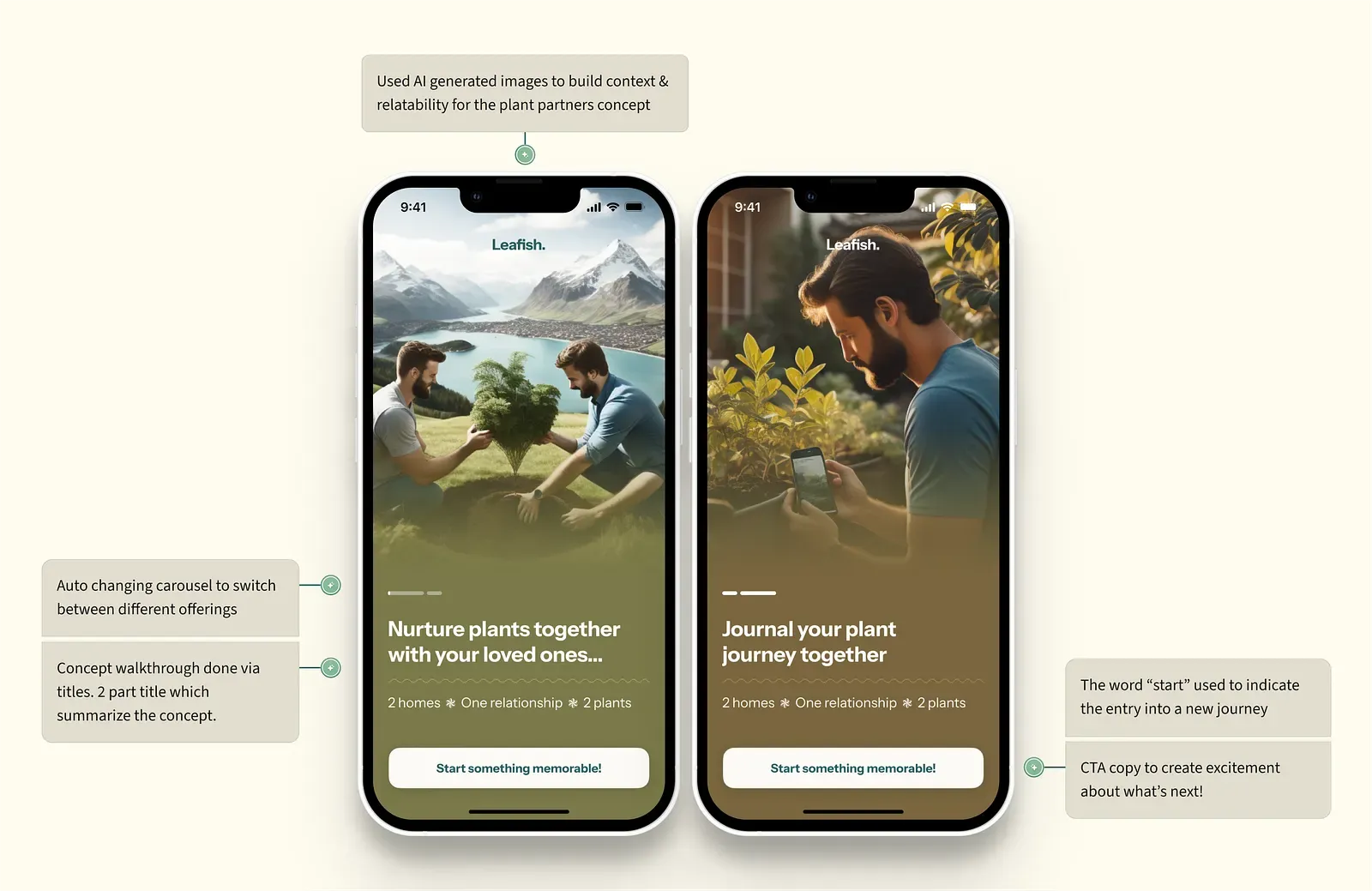
Setting the context for plant partners
Our goal for the intro screen was to spark curiosity and encourage exploration of the concept!
We focused on 2 aspects -
- Creating excitement for the concept
- Give enough context & education about the concept of plant partners & plant journalling.
Constructing FTUX for “Journeys”
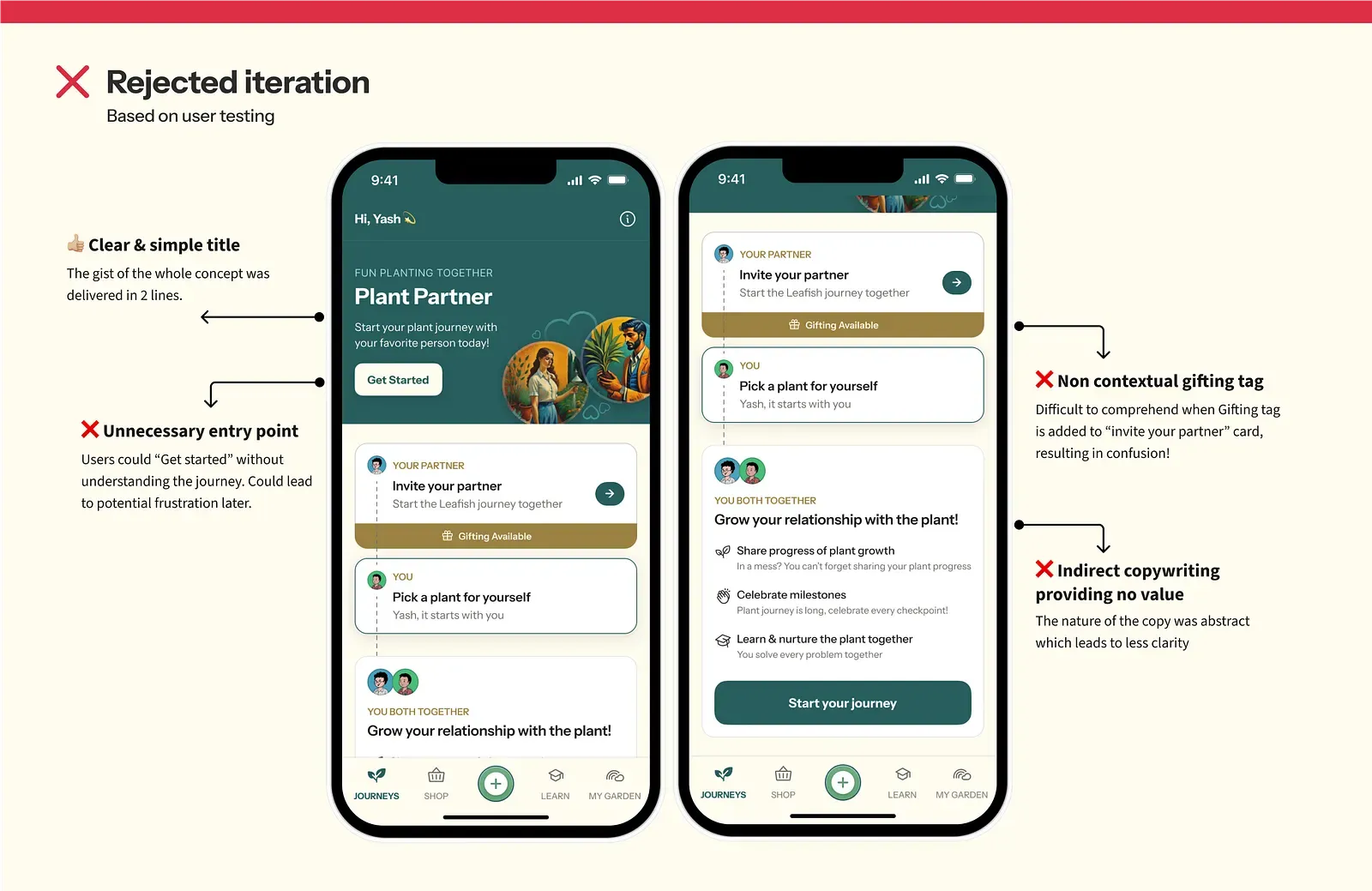
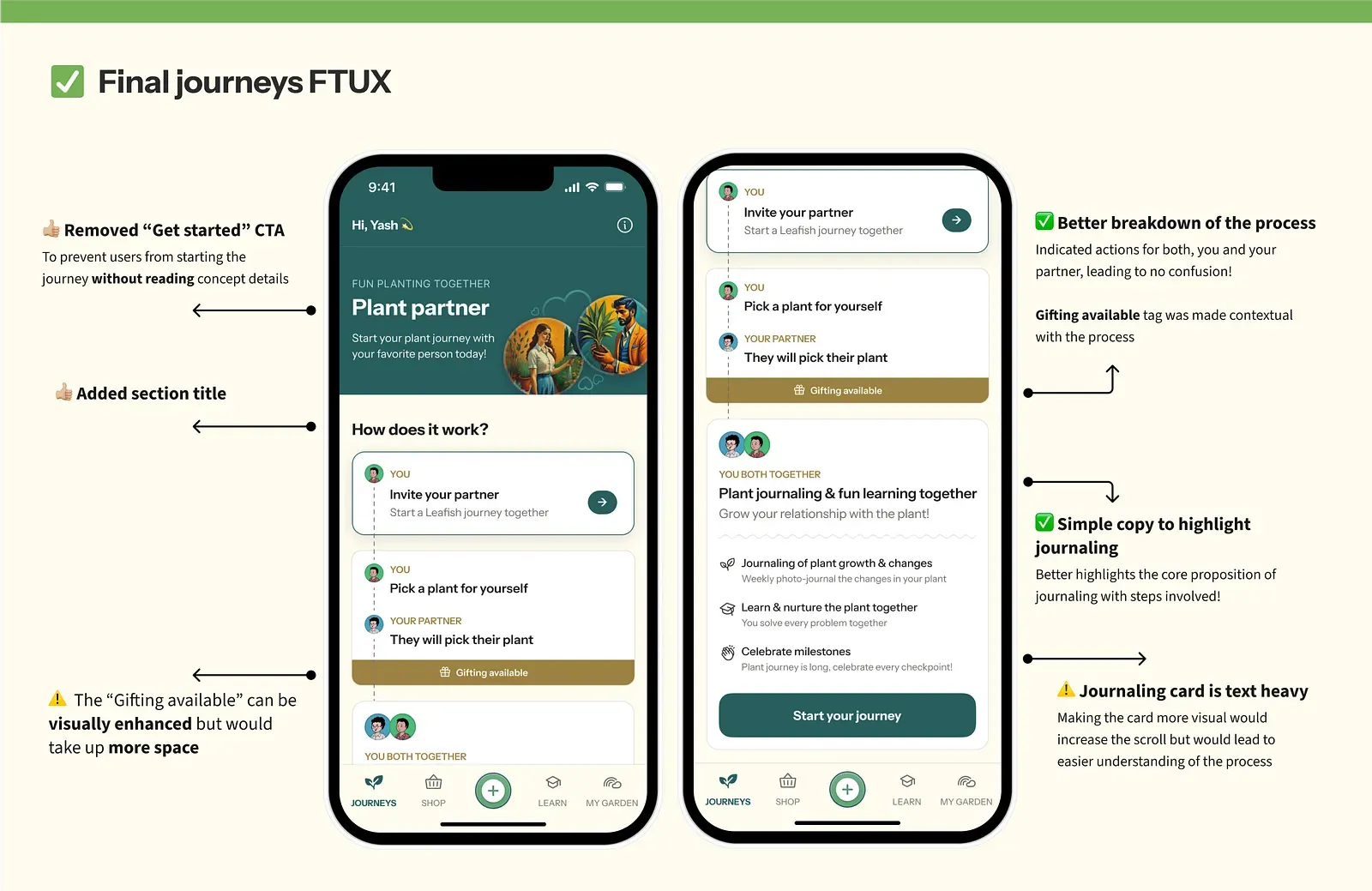
The Leafish Journeys screen is the foundation for the users to start their first plant partners’ journey.
This screen could single-handedly make or break the whole experience. If users don’t grasp the Leafish journey, it may cause drop-offs at the very start of the funnel.
Requirements for the home page
- The steps of the journey should be mentioned upfront. It enables transparency & makes the whole concept easy to understand.
- Users should recognize the importance of choosing a plant for themselves, and likewise, their plant partner will do the same. In gifting scenarios, they have the option to select for themselves and purchase a plant for their partner as well.
Let’s look at our concepts for FTUX —
Setting preferences for gifting
Gifting in Leafish is different than traditional e-commerce. For example, on Amazon, gifting would generally include selecting a plant → selecting gifting as an option → paying.
Our vision for the gifting flow — The experience of buying two plants for you and your partner should feel as liberating as crafting your favorite Subway sandwich!
The gift-shopping experience
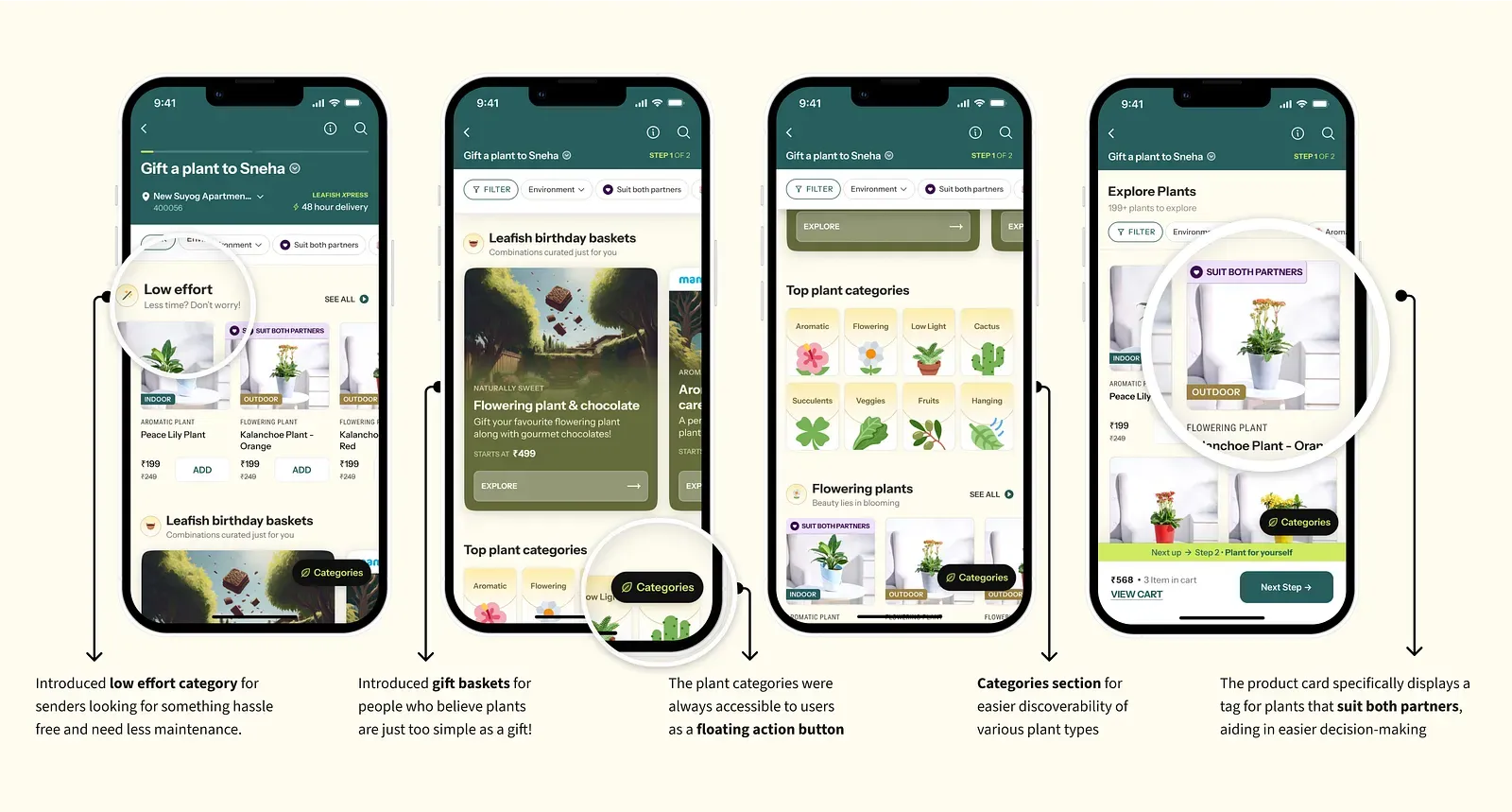
There were 3 main things we needed to consider here-

- Low effort section — Most people prefer a plant that requires low effort. This led to the creation of the top section of the shopping screen
- Only gifting plants is dull — To spice things up, we introduced baskets featuring plants and other complementary products for a more exciting gifting experience.
- Suit both partners’ tags — A consideration in plant selection was ensuring availability for both the sender and receiver. To address this, we introduced a tag for plants accessible to both, the sender and receiver!
Shortlisting the product
Now if you’re buying a plant for your partner as well as yourself —
This prompts us to consider two questions
- Why should users go through the process of choosing plants twice, back to back?
- Imagine if Yash has a cactus, which grows fully in a few days, and his friend, Sneha has a bonsai that takes longer. They wouldn’t be on the same page, right?
The answer — A simple nudge makes all the difference
Nudging users to select the same plant for themselves and the gift recipient. It not only establishes relatability between partners but also reduces friction during the buying process.
One cart, two doorsteps
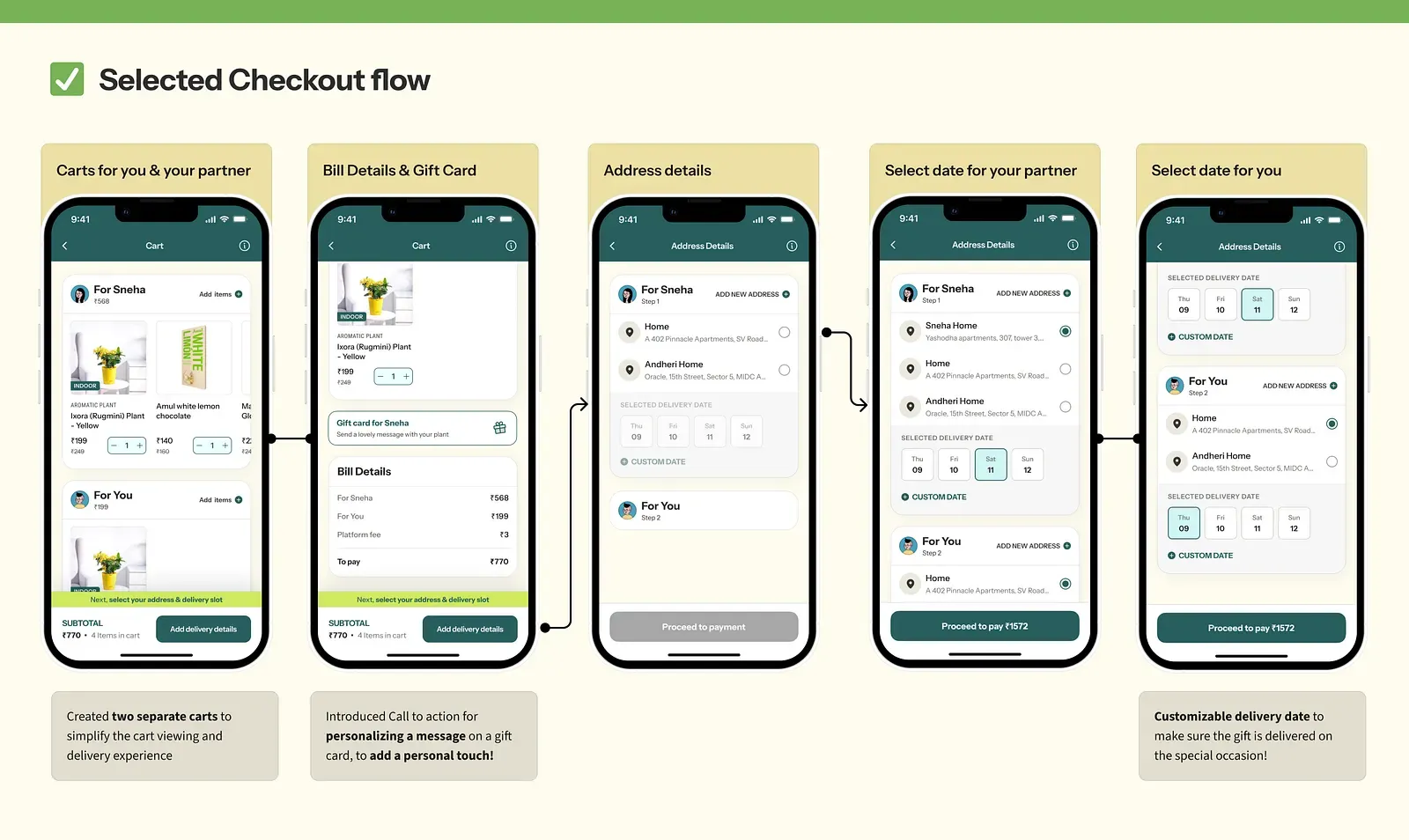
A typical multi-step checkout overwhelmed people with information and inputs. The final cart shows both orders on one screen and reveals delivery details only as they are needed.
Read the full story
Checkout flow
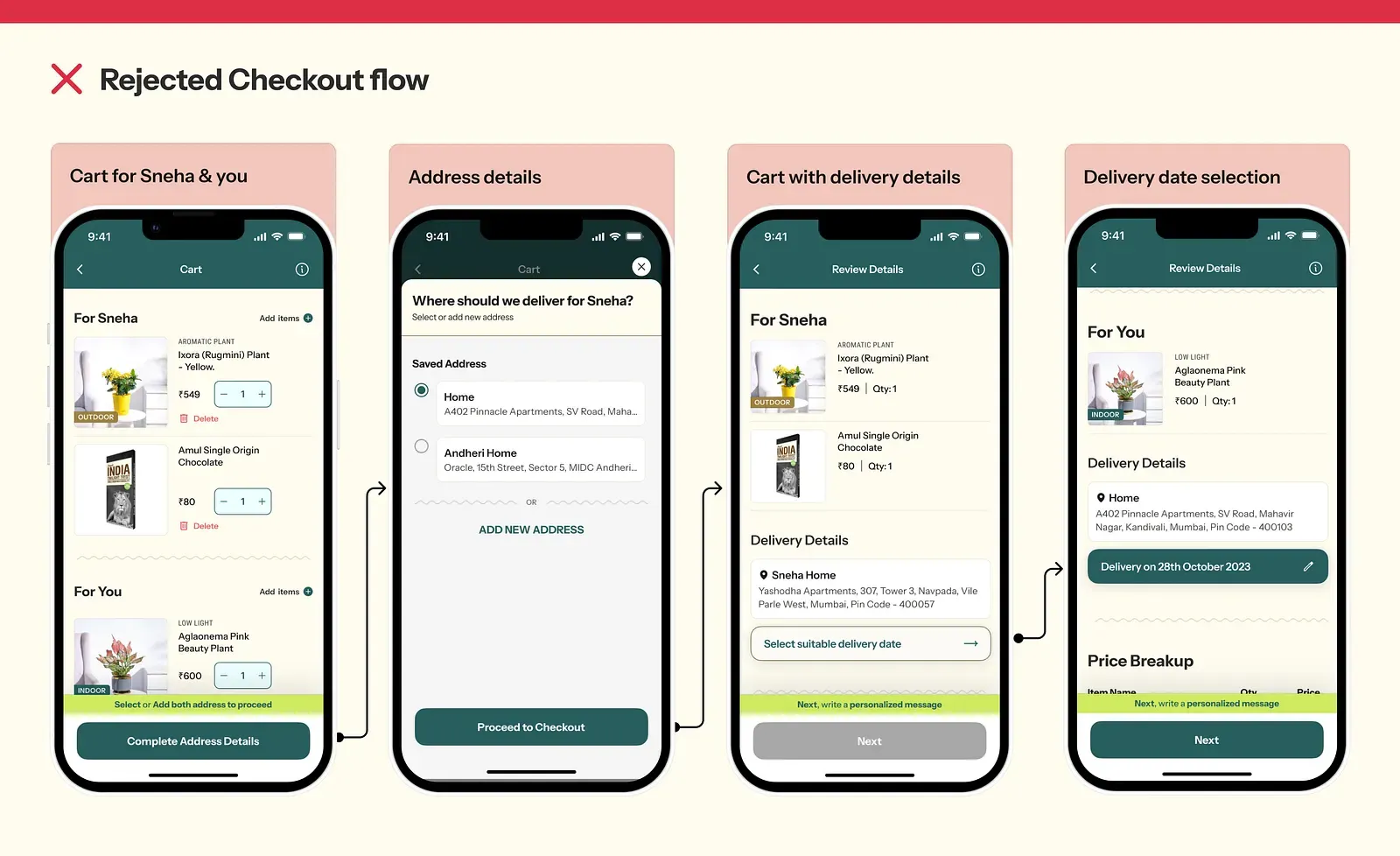
The initial cart screen design followed the typical e-commerce approach, featuring multiple steps for viewing carts, selecting and adding addresses, and customizing delivery dates.
However, this method proved ineffective due to its complexity, overwhelming users with too much information and input points.
The challenge for the checkout flow
Designing a single cart screen that incorporates the cart items, delivery addresses & delivery dates of both, the sender and receiver.
Major constraints for the cart screen-
- The user’s and their partner’s carts should be visible in the first fold along with different amounts spent on the respective carts
- The user should be able to select the address and the delivery date on the same screen.
In the final checkout flow, we decided to progressively disclose delivery details, ensuring users aren’t overwhelmed with too many decisions at once.
Now, what happens once the plants are delivered to both partners? Let’s deep dive into the post-delivery experience.
A plant diary, every Sunday
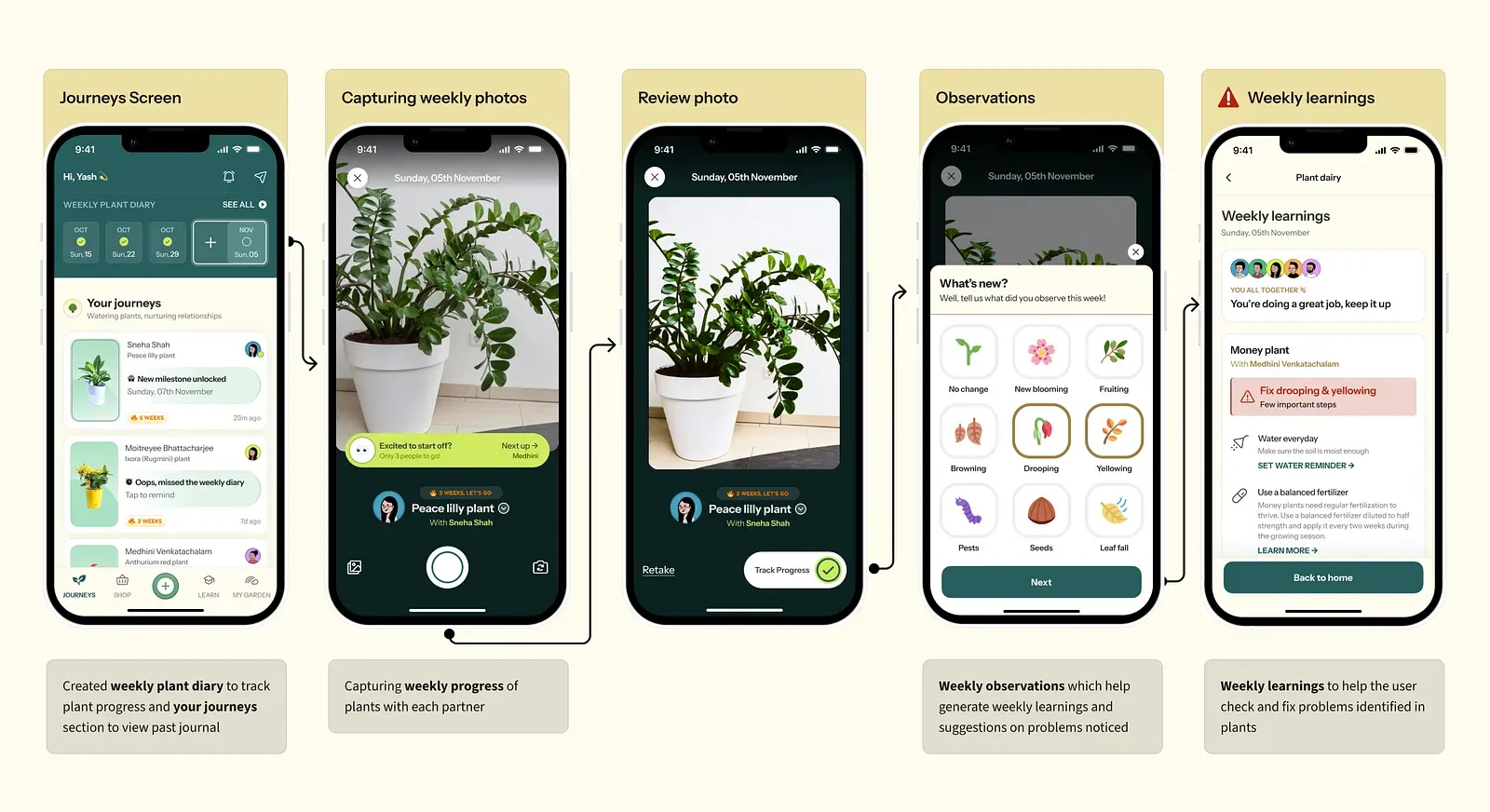
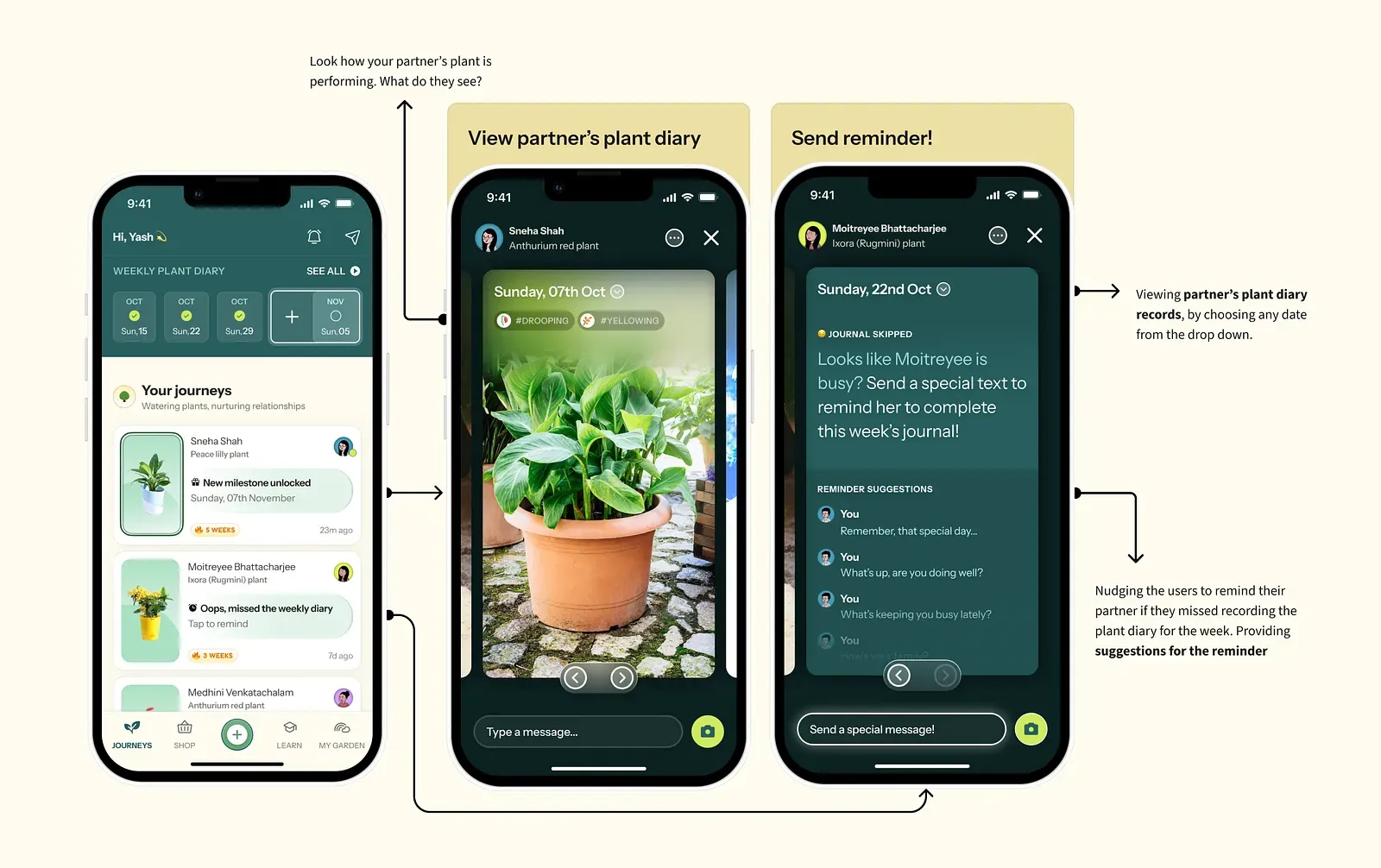
Journaling is high effort, so we kept it to once a week, on Sundays, with a single obvious entry point. Partners see each other's diaries and remind each other not to miss one.
Read the full story
The plant partners’ phase
Let’s examine gifting from a first principles standpoint.
Why do we gift? Gifting is a way to express love towards someone; indeed, it’s a love language. The true goal of Leafish is to nurture relationships through plant gifting.
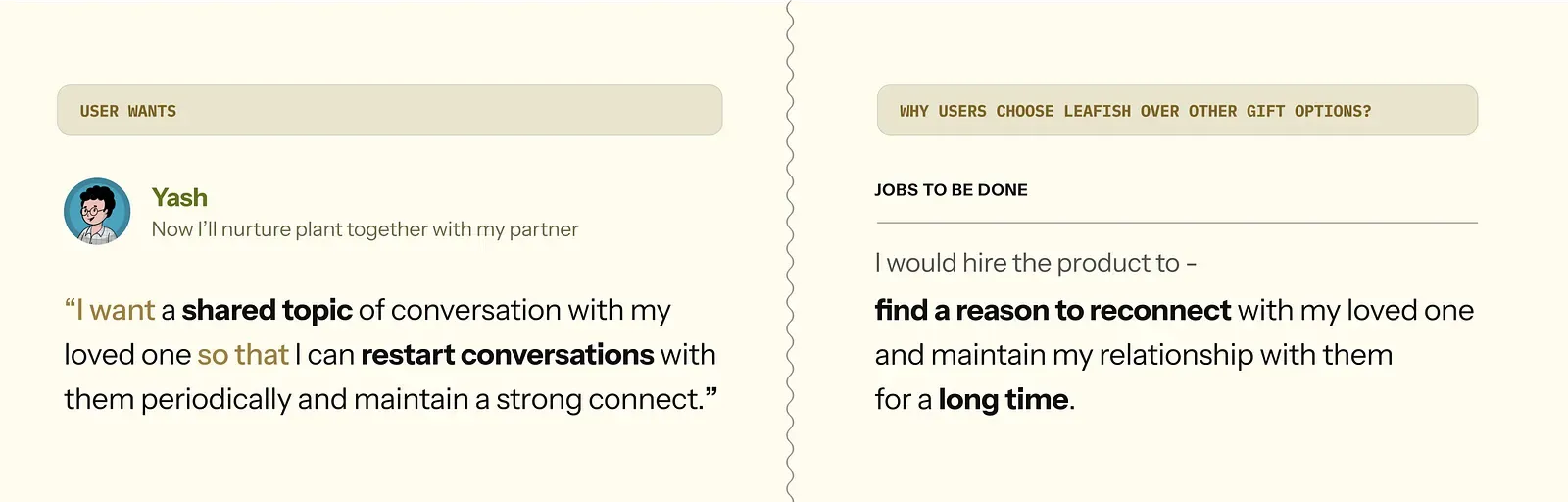
The underlying opportunity
How might we create a common point that acts as a reason to reconnect for partners to get together?
Introducing weekly plant journaling
Revisiting the concept of weekly plant journaling —
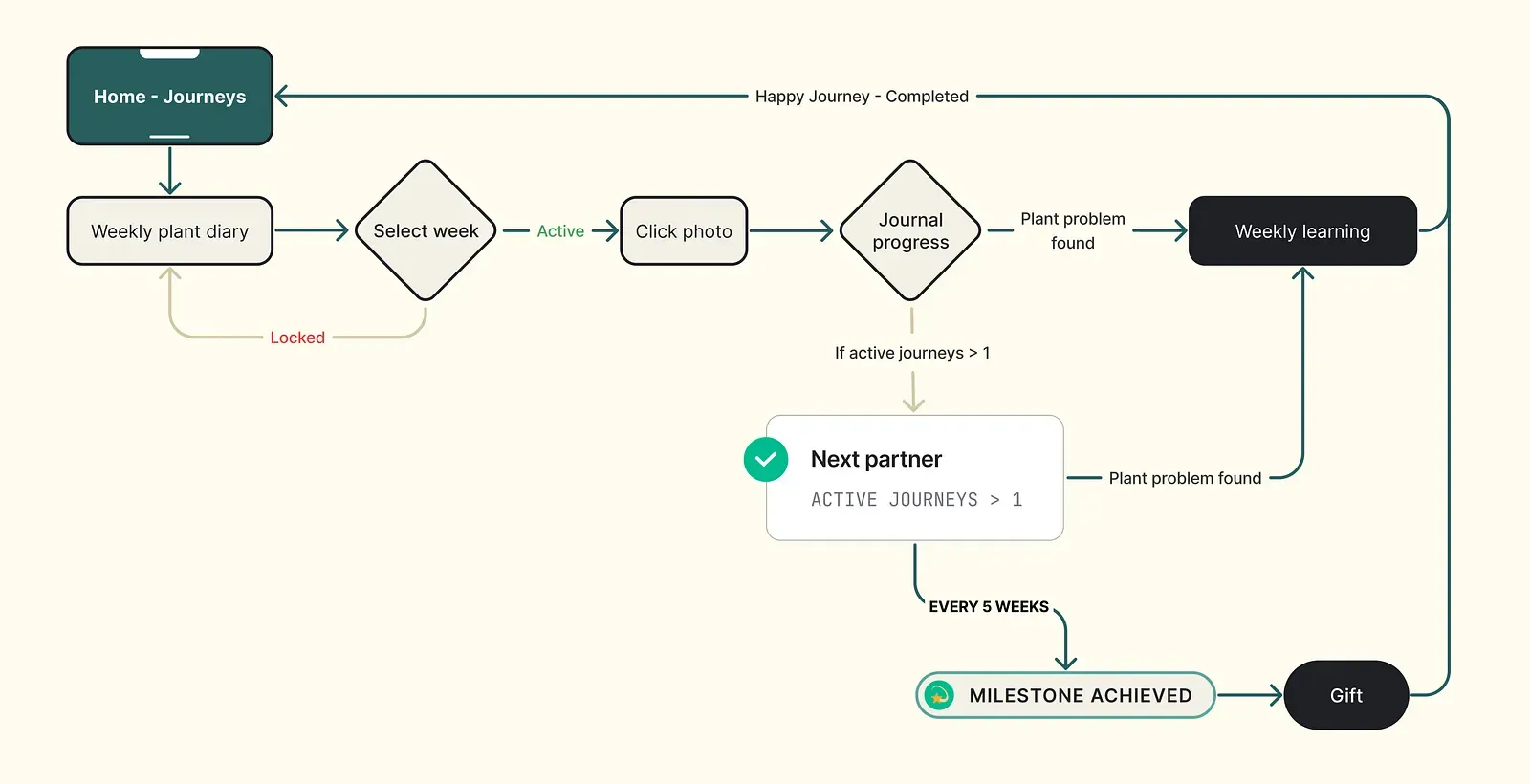
In the plant partners phase, you and your plant partner document the plant journey & progress via photos, troubleshoot any plant problems through learning on the go, and celebrate milestones together.
Defining constraints to solve for high efforts & low motivation —
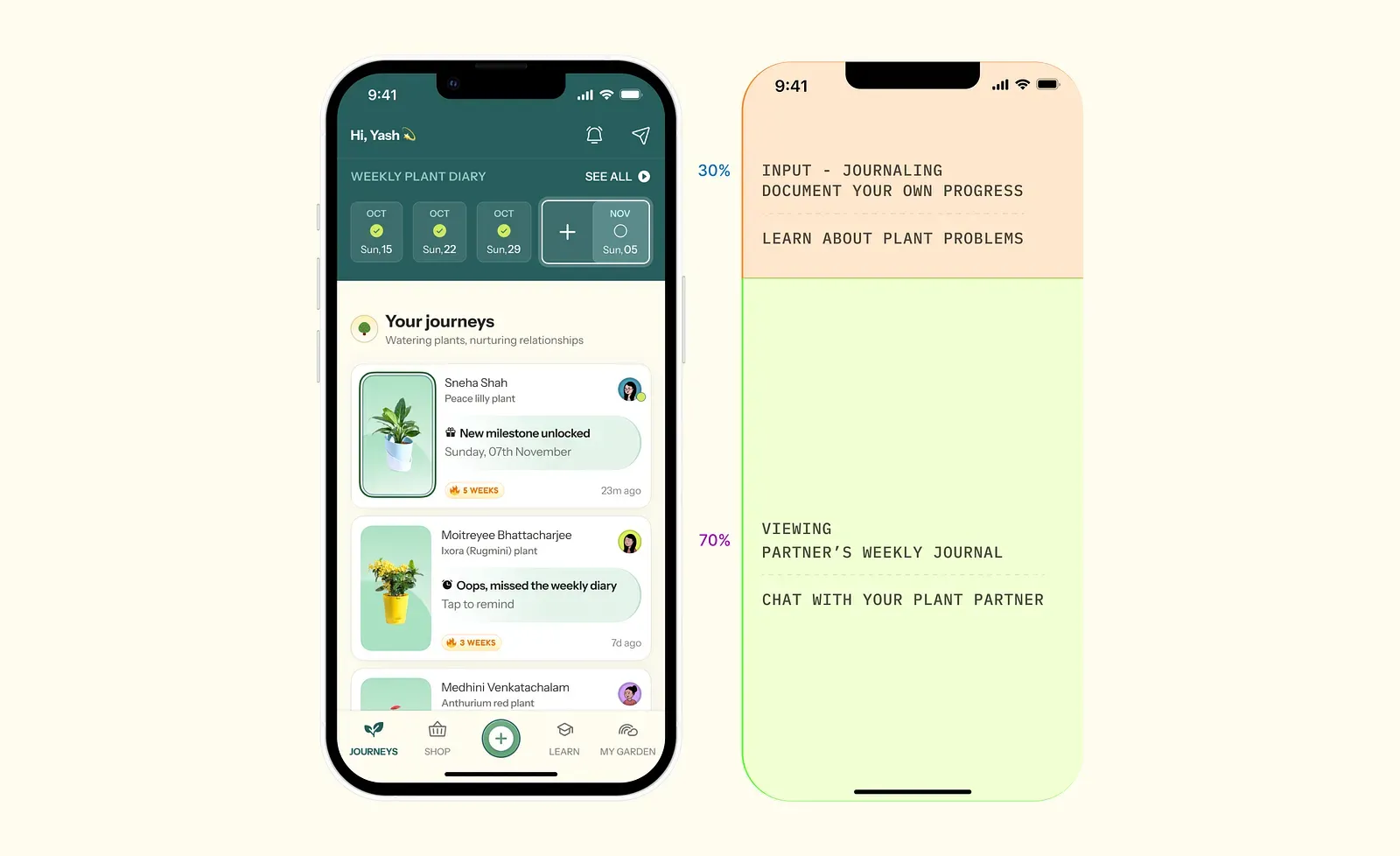
Journaling is traditionally a high-friction activity, and the missing link was the high effort & low motivation to journal.
- Journaling would occur once every week, specifically on Sundays!
- We intentionally opted for a single entry point for journaling. Upfront & easily discoverable.
- Users can journal all their plants in one go, eliminating the need to search for each plant repeatedly.
- In terms of motivation, we used triggers like “learning while journaling” & “milestones”.
To materialize this idea, we began drafting flows for the plant journaling.
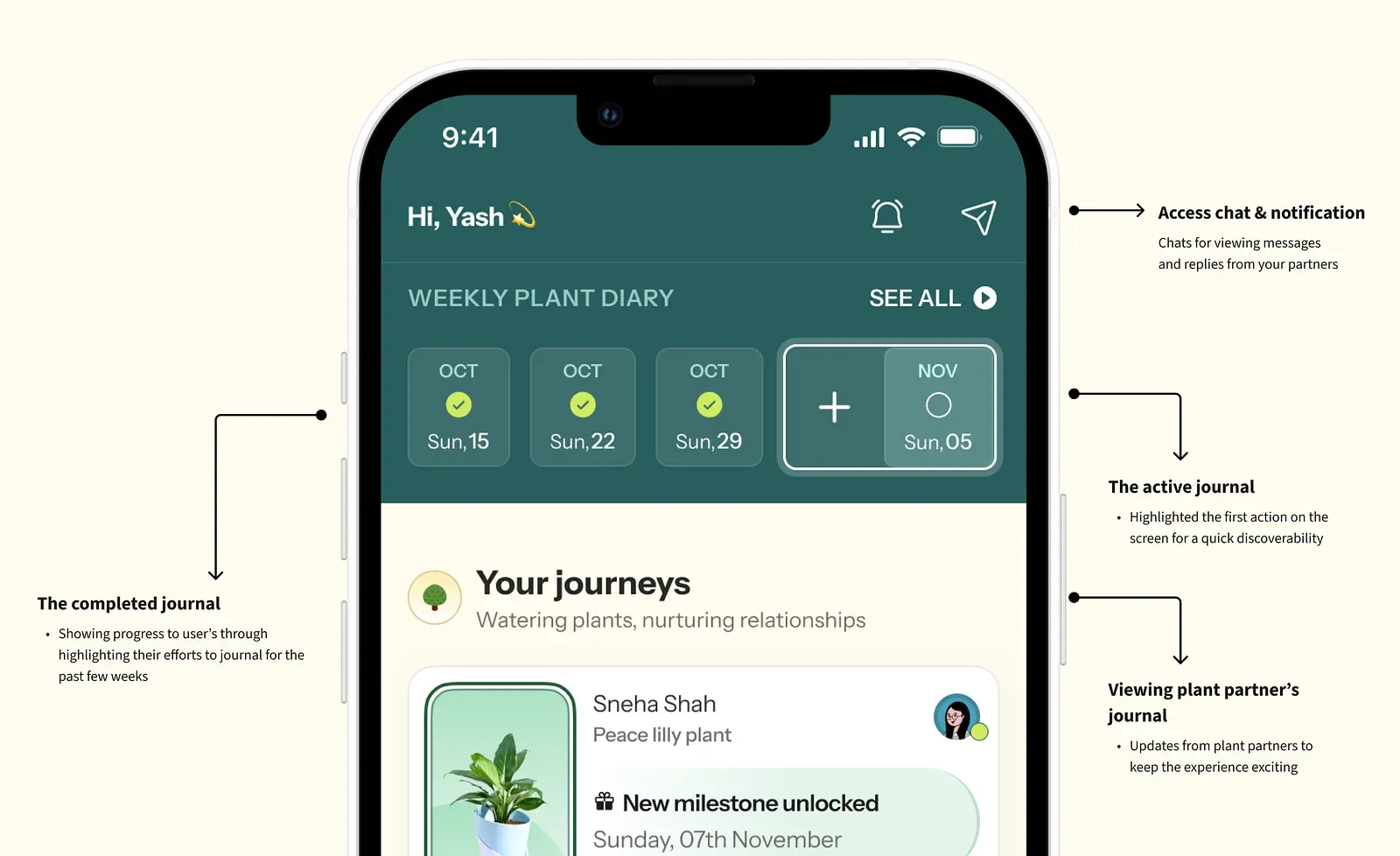
Documenting your plant journey via photos
The vision — To make the plant journaling experience as quick as having your morning tea!
Imagine it’s a Sunday morning, the sun casting a warm glow through your window. You settle into your favorite chair, a steaming cup of tea in hand. With each sip, you leisurely scroll through your social media feed, catching up on the latest updates from friends and family!
The goal — To seamlessly integrate Leafish updates into your Sunday social media routine!
Viewing your partner’s weekly plant diary
We still needed to make sure that both partners maintained their weekly plant diary. And what better way than getting the partners to remind each other and ensure that they do not miss the journaling?
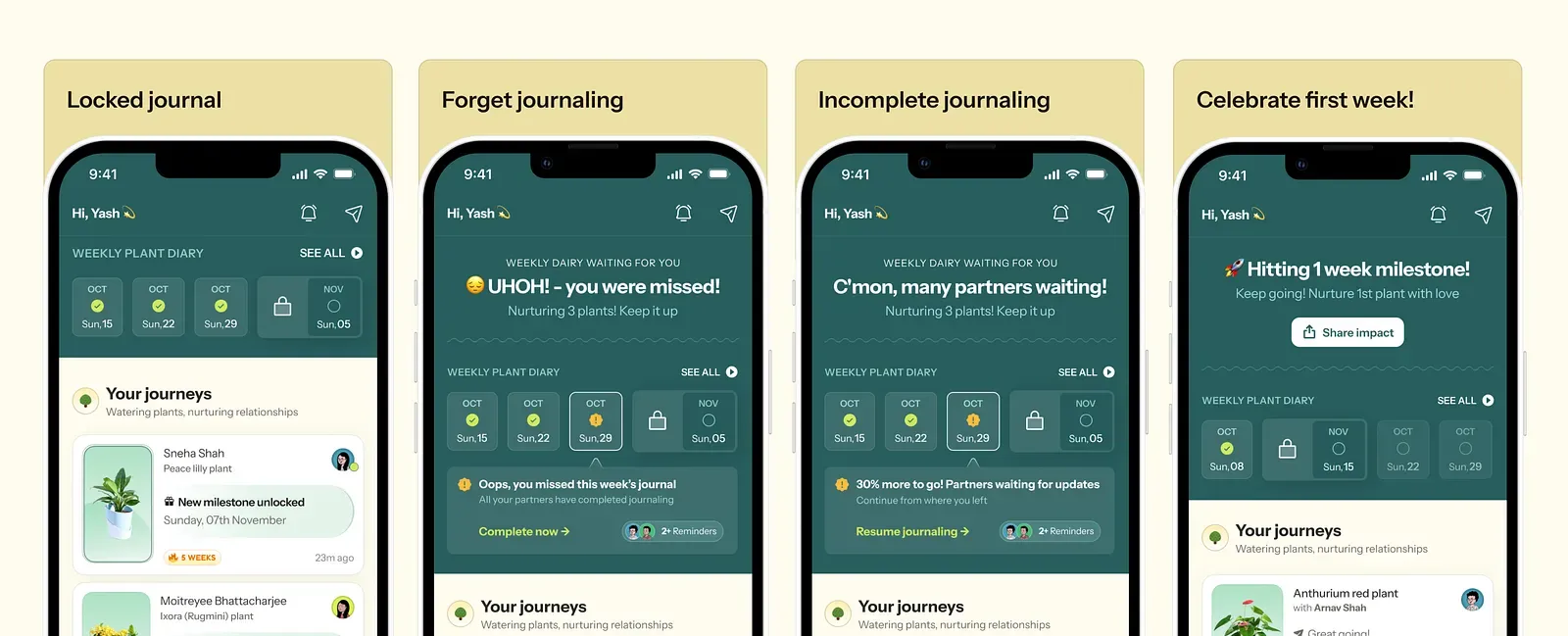
Designing for the weeks it goes wrong
High-friction habits never unfold as planned. We designed for the forgotten week, the entry interrupted by a phone call, and the very first journal.
Read the full story
To leave no stone unturned — Edge cases
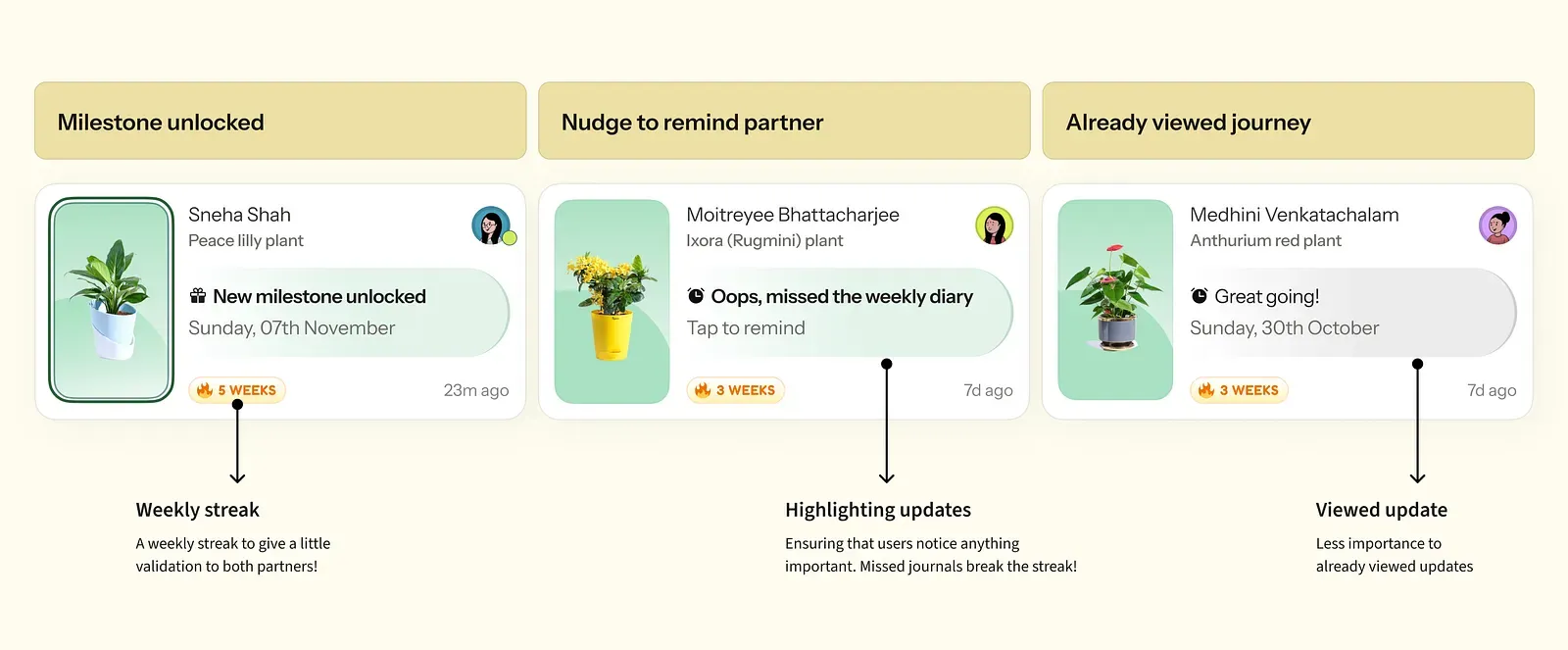
High-friction activities like journaling never unfold as smoothly as expected. We thought of scenarios where things could go wrong while journaling!
Constantly questioning ‘WHAT IF’ became our lifeline!
- What if someone wants to add progress on Thursday? The journal should be locked to prevent a decrease in relatability and progress discrepancy, aligning with our decision to journal only on Sundays.
- What if they forget to journal?
- What if a user gets an important call and has to stop the journaling midway?
- What if a user is starting their first journal — can we celebrate?
LandingThe result
- 01
Adoption
Partner journeys against solo plant gifting.
- 02
Weekly retention
People still journaling each week.
- 03
Order value
Lifted by cross-selling plant hampers.
How we would know it worked
Leafish is a concept, so there are no results to report. If it shipped, the real impact would be the number of conversations started through plant gifting.
Read the full story
Metrics to measure success
If we were to ship this design, there are some metrics we would need to monitor, to be able to measure the impact.
- Adoption — Percentage of users participating in plant journeys gifting vs. solo plant gifting.
- Weekly retention — Number of users participating in weekly plant journeys documented.
- Average order value for gifting — Increase in the AOV through cross-selling plant hampers.
The real impact would be the number of conversations ignited through plant gifting.
DebriefWhat I learned
- 01
Testing over interviews
Uncertain users show more than they tell.
- 02
A more visual first run
Bite-sized, not explained.
- 03
The recipient next
Their onboarding is still to design.
- 04
Sustainability
A gap in the solution we named.
Test more, interview less
People were unsure what they wanted, so testing taught us more than interviews did. The open question is how to keep journaling interesting after the first few weeks.
Read the full story
Time to retrospect & next steps
- With users being uncertain about what they want, we relied more & more on testing rather than interviews for insights.
- Improving the FTUX for journeys by making it more visual & bite-sized!
- Next, designing the onboarding for gift recipients.
- Users might get bored of journaling after a few weeks. How can we solve for that?
Taking the sustainability angle!
The sustainability aspect was a significant gap in the solution. Here are potential initiatives —
- For those unwilling to acquire a plant themselves, offer the option to purchase a plant that someone else in the community will plant.
- Encourage more people to adopt plants by providing the option to acquire fully grown, extremely low-effort plants. Include weekly training sessions for plant care.
- Introduce bottle plants in Leafish, creating a bottle garden.